Stage VI · Apply
From Venezuela to Notre Dame with a fully funded master's: Luis Alvarado-Bruzual's experience
Luis Alvarado-Bruzual · 3 September 2026
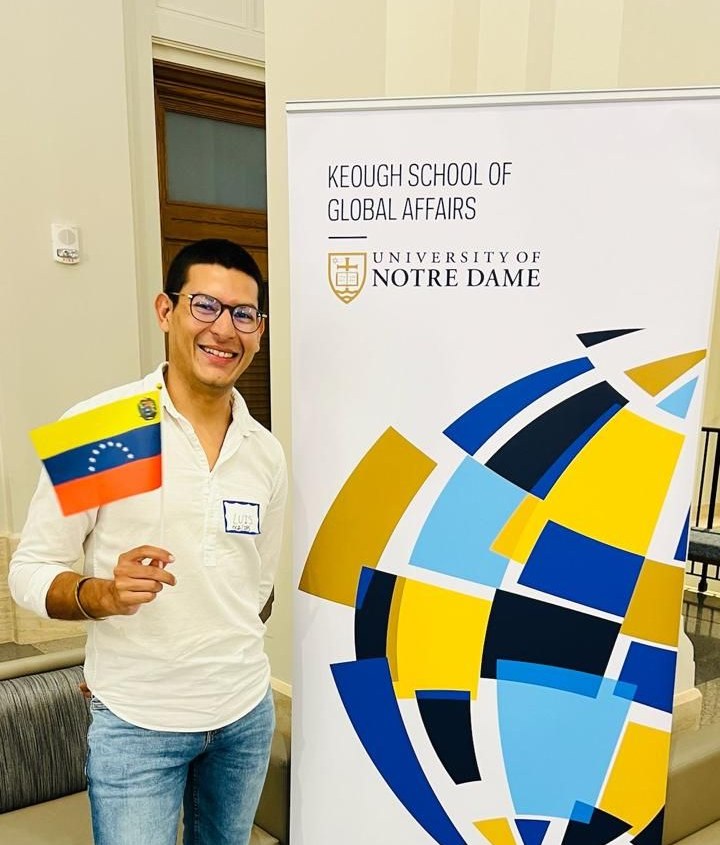
Luis Alvarado-Bruzual is from Zaraza, in the state of Guárico, Venezuela, and graduated from the Universidad Central de Venezuela. After several years working in social organizations and projects tied to international bodies, he decided to go back to studying with a very specific goal: to deepen his work in peacebuilding. He applied to a single program, the Master of Global Affairs with a concentration in International Peace Studies at the University of Notre Dame, and in 2025 he began the master's with full funding from the Kroc Institute. He's now in Los Angeles doing the six-month internship that's part of the program.
Luis had been out of a classroom for six years when he decided to go back to studying. During that time he'd built a professional track record tied to social organizations, international cooperation, and peacebuilding, so he wasn't looking for just any master's and he didn't put together a long list of universities. He found a program that connected directly to the work he was already doing, discovered that admission included full funding, and decided to concentrate all his energy on a single application.
An email that opened up a possibility
Luis learned about the program through someone in his own network. A friend who was doing a doctorate at the Kroc Institute knew he was looking at master's options and told him about Notre Dame's Master of Global Affairs. Then he did something even more useful: he connected him directly with the Director of Recruitment and Admissions.
“I found out about the program because a friend is doing his PhD with the Kroc Institute. He knew I was looking at master's options and told me the Kroc Institute ran this master's option I'm now doing. It was pretty relational: my friend connected me by email with the Director of Recruitment and Admissions and, since applications were already open, the Director shared the link to apply with me and I spent a lot of time preparing my essays and my application.”
That first contact didn't replace any part of the application, but it did let him understand the program better before deciding whether it made sense for his profile. The Kroc Institute is part of Notre Dame's Keough School of Global Affairs and runs the concentration in International Peace Studies, designed for professionals who want to work in peacebuilding, conflict resolution, and related areas.
For Luis, the fit was clear enough to make an unusual decision: not applying to any other university.
Betting on a single application
“I only applied to this university and scholarship option.”
There was quite a lot behind that decision. Luis had already accumulated professional experience in social organizations and international projects, including work tied to UNICEF and the United States Institute of Peace. Instead of widening the search by volume, he preferred to concentrate on one program that brought together the training he was after and a financial structure that made it possible to do it.
The same logic was behind the letters of recommendation. He didn't simply pick people with important titles, but professionals he'd worked with long enough that they could speak about his performance based on concrete experiences.
“I asked for the letter from three previous employers at recognized international organizations, people I'd already built a relationship of trust with over at least three years, and with whom I'd worked on at least two projects.”
Then came the essays, the academic documentation, and the English exam. Since he'd decided to bet on a single option, that application got all of his attention.
A program where the scholarship comes with the admission
One of the reasons Luis could afford such a focused strategy was the funding model of International Peace Studies.
“People who are admitted to the program receive 100% direct funding from the Kroc Institute.”
Students admitted to this concentration receive funding for the two years of the program, including tuition and a stipend to cover living expenses. The support also extends to the practical experience that's part of the master's.
Luis sums it up even more directly:
“Absolutely all the costs of the program, for its two years. It includes tuition, a stipend to cover living expenses, and health insurance.”
In his case, then, the scholarship didn't appear after the admission and it didn't require a second, separate application. It was part of the very structure of the program he was evaluating, and that was central to his being able to decide to apply.
Preparing an academic application again
After six years focused on the professional world, putting together a university file again also meant recovering some habits he hadn't needed in a long time. The requirements included the English exam, translated academic records, and essays in which he had to explain both his path and the work he wanted to develop during the master's.
“They asked me for an English as a second language certificate, but it was straightforward because they accepted the Duolingo Test. They also asked me for my undergraduate degree and certified transcripts with their corresponding official translation.”
For Luis, the application wasn't defined by any particularly difficult requirement. The challenge was more about building a coherent candidacy after several years of professional experience: connecting what he'd studied in Venezuela, the work he'd done afterward, and the questions he now wanted to bring into an academic program.
That thread ended up mattering more than piling up applications at different universities.
origin
Zaraza, Venezuela
destination
South Bend, Indiana
institution
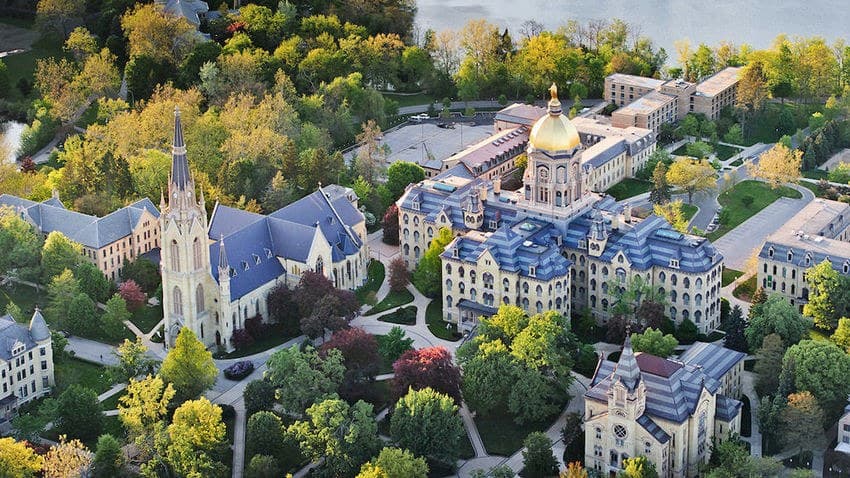
University of Notre Dame
Getting to Notre Dame after six years out of the classroom
Luis was already in the United States when he was admitted, so his transition into the university was different from that of a student who starts the whole process from Venezuela. After receiving the corresponding documentation from Notre Dame, he made the change of status needed to start as an international student.
Less than six months passed between the decision to apply and the start of the program. The most important change, though, wasn't administrative. It was getting back into the academic rhythm after six years working outside formal education settings.
“Adapting to the academic rhythm of American institutions, especially after having spent six years away from academia and from formal education settings.”
His professional experience had given him clarity about the topics he wanted to study, but it didn't remove the adjustment period. Reading, writing, and meeting the demands of an intensive master's meant rebuilding a routine he'd left behind years earlier.
There was also a more practical lesson. Although the program covers the main costs once it begins, Luis says he would have organized his finances better for the initial transition, when there are still expenses tied to moving and starting a new stage.
Six months to take theory into practice
One of the features that most distinguishes the International Peace Studies concentration is that a significant part of the second year happens off campus. Students do a six-month internship at an organization connected to peacebuilding and, at the same time, develop research of their own.
Luis is doing that stage in Los Angeles, at Homeboy Industries.
“I'm still doing my master's. Right now I'm in Los Angeles, California, doing the six-month internship required by the university's program. I'm doing it at the organization Homeboy Industries, where I'm also working on my research focus on the inclusion of art, rituals, and symbolism in the design of interventions to address collective trauma and peace processes.”
The experience connects especially clearly with what he was looking for when he decided to go back to studying. Homeboy Industries works with people trying to leave contexts tied to gangs and violence, and Luis is using the internship to go deeper into a question that crosses peacebuilding, collective trauma, and the role art, rituals, and symbols can play in processes of recovery.
The master's, then, didn't stay separate from his earlier professional experience. It became a space to organize those questions, study them in more depth, and test them in a practical context.
Going back to studying without starting from zero
For Luis, returning to university after several years didn't mean leaving behind the professional career he'd built. It was exactly the opposite: that experience was what let him arrive at the program with more concrete questions, choose better the people who would write his recommendations, and understand why that master's made sense for him.
It also changed how he thinks about academic opportunities. Having applied to a single option may look risky, but in his case it wasn't an improvised decision. He found a very specific program, confirmed it was aligned with his path, and decided to bet on it.
When he thinks about someone in Venezuela considering doing the same, his advice starts with one word.
“Apply! Every application is an impressive process of self-discovery and that in itself is one of the first gains the process offers you.”
Luis graduates in 2027. Before that he still has to complete the internship, continue his research, and go back to Notre Dame to close out a master's that started with a friend's recommendation and an email, but that fit with several years of prior work long before the link to apply showed up.
Did this story help?
Join the community